
Advance Excutive Program in High Rise & Tall Structure
Advance course for experinced structural engineer
Program Duration : 5-6 Month
Next Batch :25th Oct. 2026
Mode : Online
Live Project
Download Brochure
This is an executive program for practicing structural engineers who already design mid-rise buildings and want to move into high-rise and tall structures. It starts where standard PG courses stop. Basics are not repeated: every module is built around the problems engineers face on real towers, from choosing a lateral system to nonlinear analysis, foundation design and peer review.
Who can join this course.
learning structural engineering
Theory & Conceptual
The program offers applied theory and conceptual classes, delivering in-depth knowledge in structural engineering. It emphasizes research and development, explores modern techniques, and addresses real-world industrial challenges.
STEP 1
Software & AI integration
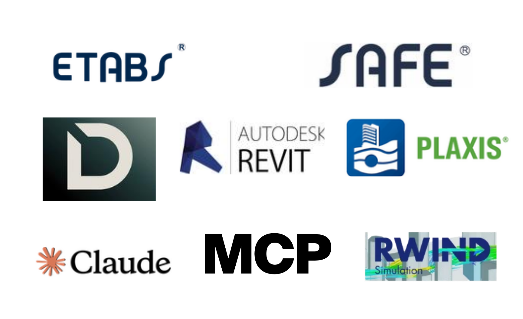
The program includes hands-on training with the latest structural engineering software such as ETABS, SAFE, REVIT PLAXIS, AI+MCP, DIANA, IFC4.3 & DUBAL RWIND, along with comprehensive manual calculation methods to build strong fundamental understanding.”
STEP 2
100+
Learner Enrolled
50%
Salary Hike
40%
Multinational Learner
4.8/5
Google Review
Program Highlight
Excellent Carriculum
Module 01: Specialized Modeling & Open BIM (Revit, IFC) (20 hours)
1• Build the diagrid with adaptive components and transfer the model to ETABS via CSiXRevit
• Produce a GA sheet set and quantity schedule
• Export to IFC 4.3 and run an acceptance check in the receiving software
Learning outcomes
• Model complex tall-building structural systems in Revit
• Move models reliably between Revit, ETABS and other tools through IFC 4.3
• Produce coordinated drawings and quantities from the BIM model
Module 02:Tall Building Structural Systems (8 hours)
2Software: ETABS
Tube systems
• Framed tube: closely spaced perimeter columns and deep spandrel beams
• Shear lag effect: why corner columns over-work and how it limits tube efficiency
• Tube-in-tube, braced tube and bundled tube systems
• Case studies: Willis Tower (bundled tube), John Hancock Center (braced tube)
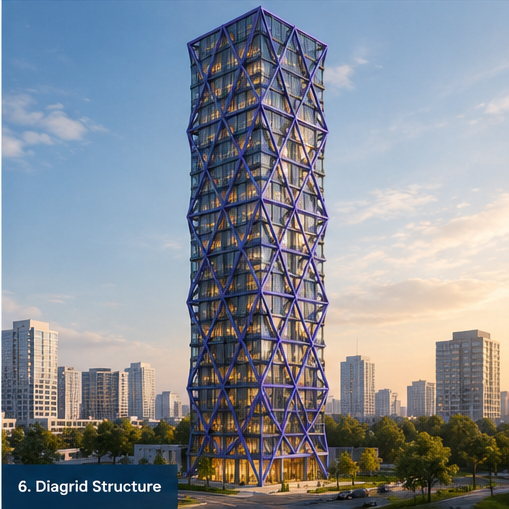
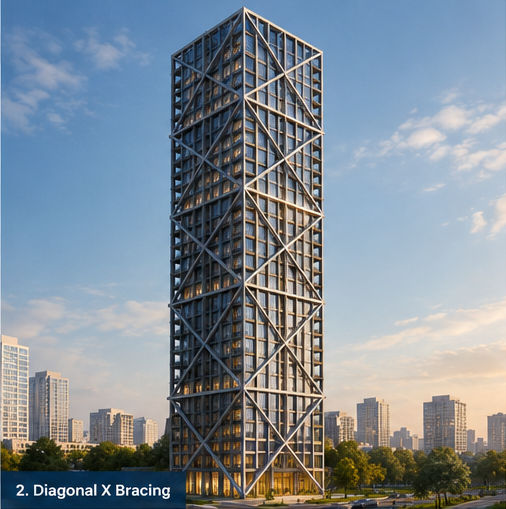
Diagrid systems
• Gravity and lateral load transfer through axial action of diagonals
• Optimal diagonal angle and module height for stiffness vs. material
• Node design, connection detailing and constructability
• Case studies: 30 St Mary Axe, Hearst Tower
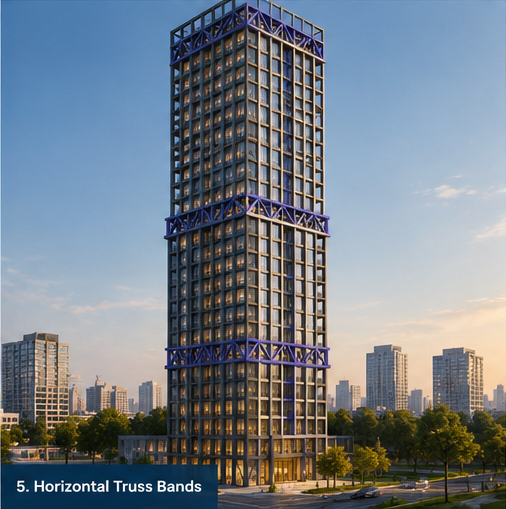
Outrigger & belt truss systems
• How outriggers engage perimeter columns to reduce core moment and drift
• Optimal location for single and multiple outrigger levels
• Belt trusses and virtual (indirect) outriggers
• Differential shortening between core and columns; delayed-connection strategies
• Case studies: Taipei 101, Shanghai Tower
Other systems & code basis
• Mega-frames and the buttressed core (Burj Khalifa)
• Transfer structures: transfer girders, transfer plates, floating columns
• IS 16700 requirements and system limits for tall buildings
• ASCE 7-22 seismic force-resisting systems, height limits and R, Cd, Ω0 (Table 12.2-1)
Hands-on
• Model a framed tube, a diagrid and an outrigger tower of the same height in ETABS
• Compare drift, fundamental period and material quantity across the three systems
Learning outcomes
• Select an appropriate lateral system for a given height, use and architecture
• Explain shear lag, diagrid action and outrigger mechanics from first principles
• Justify system choice against IS 16700 and ASCE 7-22 limits
Module 03: Advanced Analysis & Modeling (ETABS) (8 hours)
3Software: ETABS
Topics
• Construction sequence (staged) analysis and its effect on gravity force distribution
• Column shortening: elastic, creep and shrinkage; differential axial shortening
• Cracked-section stiffness modifiers for walls, beams, slabs and columns
• Rigid vs. semi-rigid diaphragms; P-Delta effects
• Horizontal and vertical irregularities per IS 1893 and ASCE 7-22 (Tables 12.3-1, 12.3-2)
• Podium–tower interaction, expansion joints and modeling per ASCE 7-22 Section 12.7
Hands-on
• Construction sequence and column shortening study on a G+40 model
Learning outcomes
• Build a defensible analysis model with documented assumptions
• Quantify differential shortening and its impact on slabs and outriggers
Module 04: Modal Analysis (6 hours)
4Software: ETABS
Topics
• Eigen vectors vs. Ritz vectors, and when to use each
• Mass source definition per IS 1893 and ASCE 7-22 (effective seismic weight)
• Mass participation: 90% per IS 1893 vs. 100% (with residual mode) per ASCE 7-22
• Reading mode shapes: translational, torsional and coupled modes
• Torsional period ratio check per IS 16700
• Higher-mode effects in tall buildings
• Modal combination: SRSS vs. CQC; directional combination
• Empirical vs. analytical period, and base shear scaling (IS 1893 and ASCE 7-22 Section 12.9)
Hands-on
• Modal study of a 40-storey tower: interpret mode shapes and fix a torsion-dominated layout
Learning outcomes
• Interpret modal results and identify torsional sensitivity
• Apply correct mass source, mode count and scaling under both codes
Module 05: Advanced Seismic Design (Response Spectrum) (6 hours)
5Software: ETABS
Topics
• IS 1893 (Part 1) vs. ASCE 7-22 Chapters 11 and 12: design spectrum, site classes, Seismic Design Categories
• Modal response spectrum analysis and scaling (ASCE 7-22 Section 12.9)
• Site-specific response spectrum (ASCE 7-22 Chapter 21)
• Soil-structure interaction (ASCE 7-22 Chapter 19)
• Accidental torsion and torsional amplification
• Diaphragms, chords and collectors (ASCE 7-22 Section 12.10)
Hands-on
• Response spectrum analysis of the same tower under IS 1893 and ASCE 7-22
Learning outcomes
• Perform and scale response spectrum analysis under both codes
• Design diaphragms and collectors for tall-building force transfer
Module 06: Time History Analysis (Linear & Nonlinear) (10 hours)
6Software: ETABS
Linear time history
• Modal time history vs. direct integration
• When linear time history adds value over response spectrum
Nonlinear time history (NLTHA)
• Fast Nonlinear Analysis (FNA) vs. direct integration (Newmark, HHT methods)
• Ground motion selection from the PEER NGA database
• Number of record pairs, period range, amplitude scaling vs. spectral matching (ASCE 7-22 Chapter 16)
• Damping for tall buildings: Rayleigh vs. modal damping
• Plastic hinges, fiber sections and nonlinear shear wall modeling
Interpreting results
• Storey drift, floor accelerations and residual drift
• Hysteresis loops and energy balance checks
• Acceptance criteria per ASCE 41-23, LATBSDC and PEER TBI
Hands-on
• Nonlinear time history analysis of a 40-storey core-wall tower in ETABS
Learning outcomes
• Select, scale and apply ground motions correctly
• Run and debug a nonlinear time history model
• Evaluate results against recognized acceptance criteria
Module 07: Performance-Based Seismic Design (PBSD) (8 hours)
7Software: ETABS
Topics
• Performance objectives: Immediate Occupancy, Life Safety, Collapse Prevention
• Service-level and MCE-level evaluation
• ASCE 41-23 nonlinear modeling parameters and acceptance criteria
• Nonlinear response history procedure per ASCE 7-22 Chapter 16
• Pushover analysis and its limits for tall buildings
• LATBSDC and PEER TBI guidelines; deformation- vs. force-controlled actions
Hands-on
• Pushover and nonlinear PBSD evaluation of the capstone tower in ETABS
Learning outcomes
• Define performance objectives and acceptance criteria for a project
• Distinguish deformation- and force-controlled actions and design for each
Module 08: Wind Engineering for Tall Buildings (10 hours)
8Software: ETABS
Topics
• IS 875 (Part 3) vs. ASCE 7-22 Chapters 26–30: wind speeds, exposure, gust effect factor for flexible buildings
• Along-wind, across-wind and torsional responses; vortex shedding
• Wind tunnel procedure (ASCE 7-22 Chapter 31) and ASCE/SEI 49 testing standard
• Reading wind tunnel reports: HFFB and pressure studies
• ASCE Prestandard for Performance-Based Wind Design
• Occupant comfort: acceleration criteria and serviceability drift under wind
Hands-on
• Dynamic wind analysis of a slender tower; across-wind and comfort checks
Learning outcomes
• Compute dynamic wind effects under IS 875 and ASCE 7-22
• Interpret wind tunnel results and apply them to design
Module 09: Damping & Response Control Systems (6 hours)
9Software: ETABS
Topics
• Tuned mass dampers (TMD) and tuned liquid dampers
• Viscous, viscoelastic and friction dampers
• Damped structures per ASCE 7-22 Chapter 18
• Seismically isolated structures per ASCE 7-22 Chapter 17
• Effect of supplemental damping on drift, acceleration and member forces
Hands-on
• Add viscous dampers to a tower and compare response with and without them
Learning outcomes
• Select a response control strategy for a given problem
• Model dampers and quantify their benefit
Module 10: Advanced Component Design (12 hours)
10Software: ETABS · SAFE
Topics
• Shear walls with boundary elements (IS 13920) and ductile wall detailing
• Diagonally reinforced coupling beams
• Composite mega-columns and steel–concrete composite design (IS 11384)
• Composite shear wall design: steel-plate and steel-encased (SRC) walls, with AISC 341 provisions
• Outrigger connections and transfer girders designed for amplified forces using Ω0 (ASCE 7-22 Section 12.3.3)
• Transfer plates and strut-and-tie basics
• Post-tensioned slabs and flat slab punching shear
Hands-on
• Design of a core wall, a coupling beam and an outrigger connection
• Design check of a composite shear wall
Learning outcomes
• Design and detail critical tall-building elements to code
• Apply overstrength and capacity design principles
Module 11: Foundations for Tall Buildings (8 hours)
11Software: SAFE · DIANA · PLAXIS
Topics
• Piled-raft foundations and design philosophy
• Pile design per IS 2911; settlement and differential settlement
• Foundation requirements per ASCE 7-22 Section 12.13
• Raft design in SAFE; introduction to PLAXIS interaction analysis
• 3D finite element analysis of pile and piled-raft foundations in DIANA
• Superstructure–foundation interaction
Hands-on
• Piled-raft design for the capstone tower in SAFE
• 3D FE model of the pile foundation in DIANA
Learning outcomes
• Select and design a foundation system for a tall building
• Estimate and control settlement
Module 12: IS vs. ASCE Comparative Design Workshop (8 hours)
12Software: ETABS
Topics
• Same tower designed under IS 1893 / IS 875 and ASCE 7-22
• Comparison of base shear, drift limits, wind loads and load combinations
• When Indian projects use ASCE: international clients, peer reviews, Middle East projects
• Companion codes in US practice: ACI 318 and AISC 341 (overview)
Hands-on
• Side-by-side comparison report for the workshop tower
Learning outcomes
• Work confidently under both IS and ASCE frameworks
• Explain code differences to clients and reviewers
Module 13: Serviceability, Documentation & Peer Review (6 hours)
13Software: ETABS · SAFE
Topics
• Drift limits per IS 1893 and ASCE 7-22 (Table 12.12-1)
• Floor vibration and long-term deflection
• Writing a Design Basis Report (DBR)
• Third-party and peer review process
• IS 16700 and ASCE 7-22 compliance checklists
Hands-on
• Prepare a DBR for the capstone tower
Learning outcomes
• Produce a complete, reviewer-ready Design Basis Report
• Run a structured compliance check
Module 14: AI Copilots & MCP Servers in Structural Engineering (4 hours)
14Software: AI copilots · MCP · ETABS API · Revit API
AI copilots in structural practice
• Where AI copilots help: model setup, load combinations, result extraction, code lookup and report drafting
• Limits and risks: hallucinated values, outdated code clauses and data confidentiality
• The engineer of record stays responsible: checking and signing off every AI output
Model Context Protocol (MCP)
• What MCP is: an open standard that connects AI assistants to external tools and data
• MCP clients, servers, tools and resources explained
• MCP servers built on the ETABS / SAP2000 API, OpenSTAAD and the Revit API
• Python scripting basics for structural software APIs
Automating tall-building workflows
• Generating grids, storeys and members from prompts
• Automated extraction of modal, drift and base shear results
• Verification discipline: independent hand checks and an audit trail of AI actions
Hands-on
• Connect an AI assistant to ETABS through an MCP server
• Generate a tower model, extract modal and drift results and verify them by hand checks
Learning outcomes
• Explain how MCP connects AI assistants to engineering software
• Use AI copilots to automate repetitive modeling and checking tasks
• Apply a verification process before relying on any AI-generated result
Module 15: Capstone Project (8 hours)
15Software: Revit · ETABS · SAFE · DIANA
Project stages
1. Architectural brief, structural system selection and justification
2. Revit BIM model, ETABS analysis model, construction sequence and column shortening study
3. Modal and response spectrum analysis under IS 1893 and ASCE 7-22
4. Dynamic wind analysis and occupant comfort checks
5. Nonlinear time history and performance-based evaluation
6. Design of core walls, coupling beams, outriggers and transfer elements
7. Piled-raft foundation design
8. Design Basis Report and final presentation to a review panel
Deliverables
• Revit BIM model with GA drawings and quantities
• ETABS, SAFE and DIANA models
• Design calculations and drawings for key elements
• Design Basis Report
• IS vs. ASCE comparison summary
• Final presentation
Download Sybullash
Download Brochure
Master 6+ Software Tools
Typical project taken in program
Outrigger & belt truss
We belive in learner review
We believe in the power of learner feedback to shape, improve, and inspire our programs
Mr. Limesh Randive
Mr. Chunnu kumar
Mr. Krishna Sharma
Mr. Hugo Henrique
Mr. Sayandeep bhattacharjee
Er Avdhesh Negi
Mr. Ishan Nagar
Get certified as Professional Engineer

Enroll Today
Be a part of India’s top course provider, let’s start your application now!
Total Program fee (Including 18% GST)
INR 65,000/-
Book your seat with INR 10,000/- only
Structurex Course benefit!
Frequently Asked Questions
Can freshers join this program?
Is the program online?
What if I miss a class?
Which codes are covered?
What is the software included?
In which language course will deliver?
How Can i solve my queries?
Do i get placement and career assistance after course complitation?
Is their gaurantee of Placement ?
From mock interviews to portfolio-building, we prepare you for the real industry.
Learn. Build. Get Hired — with StructureX.
What kind of certificate i will recive after course.
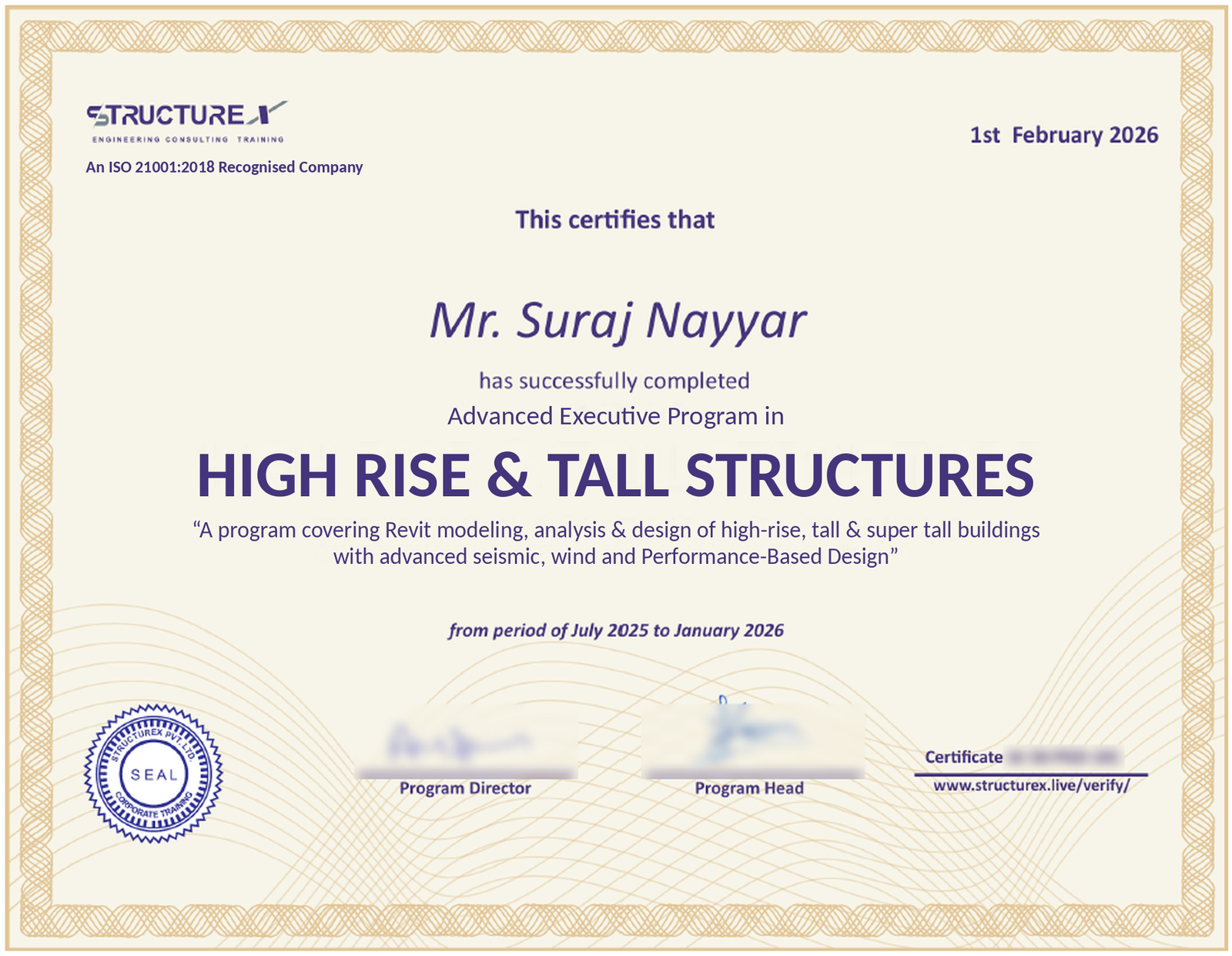
✅ Program Completion Certificate (STRUCTUREX PVT. LTD.)
Issued after completing all course modules and assessments.
✅ Internship Certificate
Recognizing your practical learning and hands-on software training during the course.
✅ Project Experience Certificate (Only upon successful submission of project work)
Awarded when you complete and submit an approved real-world project as part of the program.
Can i pay fee in instalments.
Can i get disount on the fee?
Can i Pay fee in EMI?
What is the Refund Policy.
https://structurex.live/wpautoterms-refund-policy/