
PG Program in Bridge Design & BrIM Technology
Become a bridge design engineer — analyse, design and detail RCC, PSC, steel and special bridges with MIDAS Civil, and deliver them as BrIM models in Tekla, on live projects.
Bridge design with the latest tools and international standards
A specialised program on the planning, analysis and design of bridges, built for civil and structural engineers. It blends strong theoretical foundations with hands-on work in MIDAS Civil, STAAD.Pro and Tekla — across girder, box, truss and special bridges.
Who can join
Theory, software and codes — applied to real bridges
Theory & concepts
Bridge behaviour, grillage analysis, prestressing, loading and the theoretical base you need to design safe, economical and durable bridges.
Software & manual checks
MIDAS Civil, STAAD.Pro, Tekla, IDEA StatiCa, RAM Connection and RWIND — with manual calculation of loads and checks.
IRC & global codes
IRC 5, IRC 6, IRC 21, IRC 112 and IS codes, plus AASHTO LRFD, BS 5400 and Eurocode for international projects.
Our students work on real projects
Girder, box, steel and truss bridges as live projects — plus cable-stayed, arch and suspension bridge case studies.
14 modules from girder bridges to wind simulation
RCC, PSC and steel girder bridges, box girders, truss bridges, culverts, substructures, connections, wind simulation and Tekla detailing.
01Bridge Information Modelling & Management (Tekla)
The model to build and maintain Tekla Structures is a full structural workflow solution from geometry to rebar design or connection detailing, followed by steel fabrication or precast manufacturing, all the way to erection and planning of scaffolding, concrete formworks, and pours on-site. And, when the revisions are updated during construction, the owner has an as-built model to be registered and used for asset management.
- Modelling of Bridge Structure
- Detailing of Bridge Structure Fundamentals
- Bridge Management and Report
- Bridge Fabrication detailing
- Brim Collaboration and Cloud Support.
02Bridge introduction — concepts, theory & codes
Bridge analysis and design by concepts theory and codes Code of practice: IRC:5 Section1, IRC : 6 – Section II, IRC : 21, IS : 456, IRC : 112, IS-875 (Part-1,2,3), IS : 1893, IS:1894, IRC 6-2000, ACI 318-95, AASHTO 2010 Rating, AASHTO 2018 Rating, AASHTO LRFD, AASHTO STD, BS 5400, EUROCODE
03RCC T-girder bridge design
Software: MIDAS CIVIL
- Grillage Analysis (explanation and background)
- Midas introduction (its features and drawbacks)
- Bridge section assumption and initial sizing.
- Midas Modelling of RCC girder Bridge
- Manual calculation of loads (including Seismic and wind) as per IRC 6
- Load application on structure.
- Static seismic analysis as per IRC 6
- Load Combination as per IRC 6
- Result Interpretation and Manual check of modelling (through self-weight)
- Understanding the properties of T girder (calculation)
- Design of T Girder for ULS (Bending Moment, Shear and Torsion) and SLS (Stress, Deflection and Crack Width)
04PSC composite I-girder bridge design
Software: MIDAS CIVIL
- Introduction to prestressing, types, losses, pros, and cons
- Bridge section assumption and initial sizing.
- Midas Modelling of PSC Composite I girder bridge.
- Manual calculation of loads as per IRC 6
- Load application on structure.
- RSA Response spectrum analysis as per IRC 6
- Load Combination as per IRC 6 for PSC I Girder
- Result Interpretation and Manual check of modelling (through self-weight)
- Understanding the properties of PSC I girder (calculation)
- PSC cables calculation manually
- PSC cable profiling in Midas
- Design of PSC I Girder in Midas, checking stress and its losses
05PSC box girder bridge design
Software: MIDAS CIVIL
- Bridge section assumption and initial sizing.
- Midas Modelling (line Modelling) of PSC Box girder bridge.
- Manual calculation of loads as per IRC 6
- Load application on structure.
- RSA Response spectrum analysis as per IRC 6
- Load Combination as per IRC 6 for PSC box Girder.
- Result Interpretation and Manual check of modelling (through self-weight)
- Understanding the properties of PSC box girder (calculation)
- PSC cables calculation manually
- PSC cable profiling in Midas
- Design of PSC box Girder in Midas, checking stress and its losses
- Traverse analysis of box girder
- Design of traverse section
06Steel composite I-girder bridge design
Software: MIDAS CIVIL/STAAD.Pro
- Introduction to Steel bridges, their pros and cons
- Bridge section assumption and initial sizing.
- Steel Composite I girder bridge. Grillage analysis
- Manual calculation of loads as per IRC 6
- Load application on structure in Midas pro.
- Load Combination as per IRC 6 for PSC I Girder
- Result Interpretation and Manual check of modelling (through self-weight)
- Understanding the properties of steel I girder (calculation)
- Design of Steel I Girder in Excel for Bending Shear and Stresses.
- Introduction about connections and its type
- Design of connection in excel.
07Steel truss bridge design
Software: MIDAS CIVIL/STAAD.Pro
- Introduction to Steel truss bridges, their pros and cons
- Bridge section assumption and initial sizing.
- Manual calculation of loads as per IRC 6
- Load application on structure in Midas . (wind loading calculation)
- Load Combination as per IRC 6 for PSC I Girder
- Result Interpretation and Manual check of modelling (through self-weight)
- Understanding the truss analogy, tension, and compression members
- Design of Steel truss in Excel for Bending Shear and stresses.
- Detailing of Structure (only shown in paint/drawing)
08Box culvert design
Software: MIDAS CIVIL
- Introduction to box culvert, its types of pros and cons
- Culvert section assumption and initial sizing.
- Plate Modelling of box culvert.
- Plate analysis of box culvert
- Manual calculation of loads as per IRC 6 (Soil and water loads)
- Live load distribution on culvert
- Load application on structure.
- Load Combination as per IRC 6 for box culvert
- Result Interpretation and Manual check of modelling (through self-weight)
- Base pressure and uplift checks
- Design of box culvert for ULS (Bending Moment, Shear and Torsion) and SLS (Stress, Deflection and Crack Width)
- Detailing of Structure (only shown in paint/drawing)
09Foundation, substructure, slab & abutment design
- One foundation design should be done through Soil structure interaction analysis.
- Design of pile and piers as per SP 16
- Design of Pier cap and pile cap as per bending theory
- Design of pile and pier as per any nonlinear design analysis software (Adsec, ASBD, GSD)
- One slab design from all grillage models will be done through traverse analysis of slab.
- Load distribution due to live load will be done as per IRC 112
- Design of slab for 1m width will be done as per IRC 112
10Special bridge case study & research
- Only with predeveloped model will be taken under consideration
- Extradosed cum balanced cantilever Bridge
- Cable Stay Bridge
- Response Spectrum Time History Powerful Nonlinear Analysis tools associated with either geometric
11Steel bridge connection design & analysis
RAM Connection and Idea Statica can be used stand alone Automated Connection Design Designing, checking, and optimizing shear, moment, gusset, splice, bracket, base plate, and truss connections, according to AISC (ASD or LRFD), EN 1993, BS 5950, IS 800, GB 50017
- AS4100, and NZS 3404 has never been this automated.
- Connection Families (Joint Types)
- Single Plate (SP) Connections – Shear
- Designing Moment Connection
- Designing Gusset Connection
- Designing Base plate Connection
- Designing Splice Conne
12Wind simulation of bridge structures
RWIND Simulation Case Setup RWIND Simulation software, developed by companies PC-PROGRESS and DLUBAL, was designed as specialized tool for rapid CFD simulations of wind load on large variety of structures. RWIND Simulation works as standalone software, or it can be directly connected with structural design software RFEM or RSTAB. RWIND Simulation user interface is super ease of use with minimal necessary settings and user skills. The work flow is very simple. The input for RWIND Simulation is the surface model of the structure(CAD,.STL). The virtual wind tunnel is created around the structure. Wind speed is set. There st of the parameters are not mandatory, but available.
13Detailing of bridge structures in Tekla
- Only in Tekla Structure
- Fabrication
- Construction
- Management
- Reports
14Finalization & design-based report
Bringing it all together — final design-based report for your project.
Master 6 software tools used on real bridges
Analyse and design in MIDAS Civil and STAAD.Pro, design connections in IDEA StatiCa and RAM Connection, simulate wind in RWIND and detail in Tekla Structures.

Triple certification that proves what you can do
Each certificate stands for a different part of your work — learning, practice and project delivery.
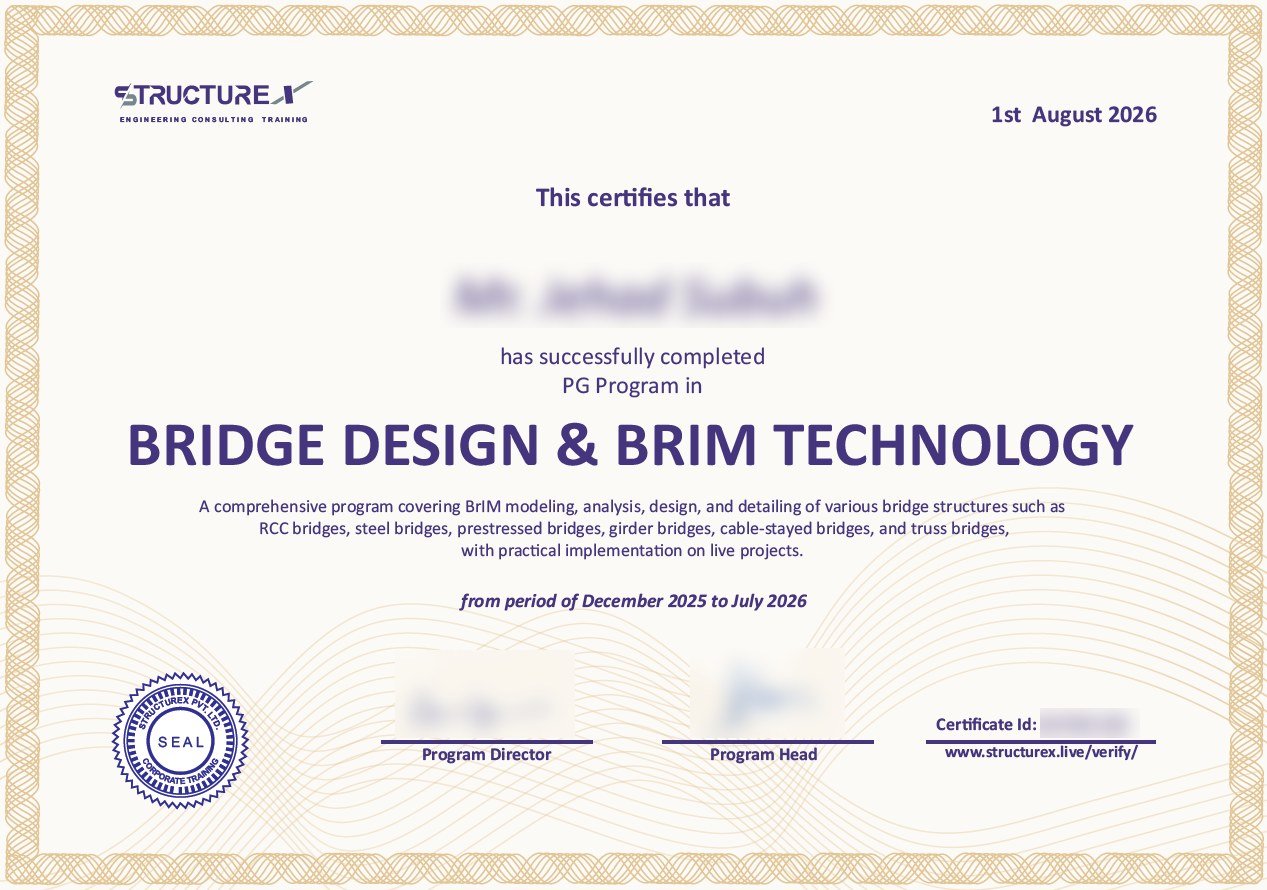
Program Completion Certificate
Issued after completing all modules and assessments.
Internship Certificate
Recognises your hands-on, practical software training.
Project Experience Certificate
Awarded when you submit an approved real-world project.
Start your application
Seats are limited — book yours in a few simple steps.
Program benefits
- No-cost EMI on credit cards
- 📅 See upcoming batch dates →
What our learners say
Hear from students and working professionals who upskilled with StructureX and moved ahead in their careers.
I had a very good learning experience at StructureX Pvt. Ltd. The training was practical and helped me improve my understanding of structural design, especially in high-rise and tall building structures. Special thanks to Aman Sir and Kareem Sir for their guidance, technical knowledge I would highly recommend StructureX Pvt. Ltd. To civil/structural engineering professionals who want to enhance their structural design skills. Lots of Thank you again.

I recently completed the PG in High-Rise Structure Design course, and it has been an excellent learning experience. The course is well-structured, practical, and focuses on real-world structural engineering concepts rather than just theory. The sessions covered key topics such as structural analysis and design of high-rise buildings, seismic design principles, wind load considerations, ETABS modeling, foundation design, and various IS code provisions. The explanations were clear, and the case studies and practical examples helped me understand how these concepts are applied in actual projects.

I recently completed the Structural Analysis and Design course for High-Rise Buildings with StructureX. The instructor demonstrated an impressive depth of knowledge and explained every aspect of the course in a clear and structured manner. I highly recommend this course to civil engineers looking to transition into professional structural engineering. It provides invaluable insights and practical expertise essential for working on high-rise building projects.

Best learning experience in the field of civil engineering. Due to my study I improve: Creativity and flexibility. Communication Skills, Technical Skills, Project Management, Critical Thinking. StructureX for me was the most important time of studying civil engineering in the last 5 years.

All the sessions are very good, and well explained, but my major expectation is to get a very supportive environment with StructureX team in the near future and looking forward to work together in the near future.

I took the High Rise Structure Design course and joined the journey with StructureX Pvt. Ltd. The course was well planned and detailed. Schedule of classes was on time and faculties were always responsive for doubts. Also, they supported in software tools explanation & study materials.

Best corporate training program and engineering educational service, associated with construction professionals who assists you to develop you skills and guide you to expertise in this growing AEC Industry.

Frequently asked questions
Is the program live or recorded?
100% live online, with recordings and learning material you can access for life.
How much time do I need each week?
3–4 live sessions a week of about 2 hours each, plus around 8 hours of self-practice and project work.
Why is the program 8 months long?
It covers many bridge types — RCC, PSC, steel, truss and special bridges — plus BrIM. The duration lets you work through each one properly.
Can freshers join?
Yes. You need a degree or diploma in Civil Engineering (or a related field) with a basic understanding of structural concepts.
Which software is included?
MIDAS Civil, STAAD.Pro, Tekla Structures, IDEA StatiCa, RAM Connection and RWIND.
Which codes are covered?
IRC 5, IRC 6, IRC 21, IRC 112, IS 456, IS 875, IS 1893, plus AASHTO LRFD, BS 5400 and Eurocode.
I don’t have the software installed. Can I still join?
Yes. Our team guides you through the setup before the program starts.
What language is the program taught in?
English.
Do I get career assistance?
Yes — profile building, mock interviews, 1-on-1 mentoring and job feeds, plus 10 guided career sessions.
Is placement guaranteed?
No program can honestly guarantee placement — but we give 100% career support so you are ready for the industry.
Which certificates will I receive?
Program Completion Certificate, Internship Certificate and Project Experience Certificate.
What is the program fee?
₹75,000 including 18% GST. You can book your seat with ₹10,000.
Can I pay in EMI?
Yes. No-cost EMI is available on credit cards (converted by your bank).
What is the refund policy?
The seat booking fee is non-refundable. You can request a fee refund up to 1 week before the program starts. See our refund policy.
Ready to design your first bridge?
Seats are limited. See upcoming batches
PG in Bridge Design & BrIM Technology
Most Advance course in India to become Bridge Design Engineer
Program Duration : 5-6 Month
Next Batch :25th Nov. 2026
Registration Closing : 22nd Nov.2026
Mode : Online
Get the program brochure
Curriculum, Software, Fee & Other details
🔒 We respect your privacy. No spam.
The StructureX Bridge Design Program is a specialized training course focused on the planning, analysis, and design of bridges using the latest software tools and international standards. Tailored for civil and structural engineers, this program offers a perfect blend of theoretical foundations and hands-on practical application.
Who can join this course.
Professional, Impactful & Job-Oriented
100%
E-learning + Live session Guidance
140+
Learning Hour
5+
Industry relevent software
6+
Projects
learning structural engineering
Theory & Conceptual
A strong theoretical base is essential for designing safe, economical, and durable bridges. The StructureX Bridge Design Program emphasizes deep conceptual clarity alongside practical applications. This module bridges academic understanding with real-world engineering demands
STEP 1
Software and Manual
The program includes hands-on training with the latest structural engineering software such as Tekla Structure, MIDAS CIVIL, CSI BRIDGE, IDEA STATICA, and DUBAL RWIND. Details, along with comprehensive manual calculation methods, to build a strong fundamental understanding.”
STEP 2
100+
Learner Enrolled
50%
Salary Hike
40%
Multinational Learner
4.8/5
Google Review
Excellent Carriculum
Bridge Information Modeling & Management
11. Modelling of Bridge Structure,
2. Detailing of Bridge Structure Fundamentals,
3. Bridge Management and Report,
4. Bridge Fabrication detailing,
5. Brim Collaboration and Cloud Support.
Bridge Introduction & Module
2RCC T Girder Bridge Design
3• Grillage Analysis (explanation and background)
• Midas introduction (its features and drawbacks)
• Bridge section assumption and initial sizing.
• Midas Modelling of RCC girder Bridge
• Manual calculation of loads (including Seismic and wind) as per IRC 6
• Load application on structure.
• Static seismic analysis as per IRC 6
• Load Combination as per IRC 6
• Result Interpretation and Manual check of modelling (through self-weight)
• Understanding the properties of T girder (calculation)
• Design of T Girder for ULS (Bending Moment, Shear and Torsion) and SLS (Stress, Deflection and Crack Width)
PSC Composite I Girder Bridge Design
4• Introduction to prestressing, types, losses, pros, and cons
• Bridge section assumption and initial sizing.
• Midas Modelling of PSC Composite I girder bridge.
• Manual calculation of loads as per IRC 6
• Load application on structure.
• RSA Response spectrum analysis as per IRC 6
• Load Combination as per IRC 6 for PSC I Girder
• Result Interpretation and Manual check of modelling (through self-weight)
• Understanding the properties of PSC I girder (calculation)
• PSC cables calculation manually
• PSC cable profiling in Midas
• Design of PSC I Girder in Midas, checking stress and its losses
PSC Box Girder Bridge Design
5• Bridge section assumption and initial sizing.
• Midas Modelling (line Modelling) of PSC Box girder bridge.
• Manual calculation of loads as per IRC 6
• Load application on structure.
• RSA Response spectrum analysis as per IRC 6
• Load Combination as per IRC 6 for PSC box Girder.
• Result Interpretation and Manual check of modelling (through self-weight)
• Understanding the properties of PSC box girder (calculation)
• PSC cables calculation manually
• PSC cable profiling in Midas
• Design of PSC box Girder in Midas, checking stress and its losses
• Traverse analysis of box girder
• Design of traverse section
Steel Composite I Girder Bridge Design
6• Introduction to Steel bridges, there pros and cons
• Bridge section assumption and initial sizing.
• Steel Composite I girder bridge. Grillage analysis
• Manual calculation of loads as per IRC 6
• Load application on structure in Midas pro.
• Load Combination as per IRC 6 for PSC I Girder
• Result Interpretation and Manual check of modelling (through self-weight)
• Understanding the properties of steel I girder (calculation)
• Design of Steel I Girder in Excel for Bending Shear and Stresses.
• Introduction about connections and its type
• Design of connection in excel.
Steel Truss Bridge Design
7• Introduction to Steel truss bridges, there pros and cons
• Bridge section assumption and initial sizing.
• Manual calculation of loads as per IRC 6
• Load application on structure in Midas . (wind loading calculation)
• Load Combination as per IRC 6 for PSC I Girder
• Result Interpretation and Manual check of modelling (through self-weight)
• Understanding the truss analogy, tension, and compression members
• Design of Steel truss in Excel for Bending Shear and stresses.
• Detailing of Structure (only shown in paint/drawing)
Box Culvert Design
8• Introduction to box culvert, its types of pros and cons
• Culvert section assumption and initial sizing.
• Plate Modelling of box culvert.
• Plate analysis of box culvert
• Manual calculation of loads as per IRC 6 (Soil and water loads)
• Live load distribution on culvert
• Load application on structure.
• Load Combination as per IRC 6 for box culvert
• Result Interpretation and Manual check of modelling (through self-weight)
• Base pressure and uplift checks
• Design of box culvert for ULS (Bending Moment, Shear and Torsion) and SLS (Stress, Deflection and Crack Width)
• Detailing of Structure (only shown in paint/drawing)
Foundation, substructure, Slab & Abdubment Design
9• Design of pile and piers as per SP 16
• Design of Pier cap and pile cap as per bending theory
• Design of pile and pier as per any nonlinear design analysis software (Adsec, ASBD, GSD)
• One slab design from all grillage models will be done through traverse analysis of slab.
• Load distribution due to live load will be done as per IRC 112
• Design of slab for 1m width will be done as per IRC 112
Special Bridge Case study & Research
10• Extradosed cum balanced cantilever Bridge
• Cable Stay Bridge
• Response Spectrum Time History Powerful Nonlinear Analysis tools associated with either geometric
Steel Bridge Connection Design and Analysis
11AS4100, and NZS 3404 has never been this automated.
1. Connection Families (Joint Types)
2. Single Plate (SP) Connections – Shear
3. Designing Moment Connection
4. Designing Gusset Connection
5. Designing Base plate Connection
6. Designing Splice Conne
Wind Simulation of Bridge Structure
12Detailing of different type of bridge structure using 3D Model in Tekla structure and design input
13• Fabrication
• Construction
• Management
• Reports
Finalization and Design Based Report
13Master 6 Software Tools

Typical project taken in program
RC/I-Girder Bridge
Steel bridge (I-Guider & Truss type)
PSC BOX Girder/ Box Culvert
Cable stay/Balance Cantiliver- Case Study
Arch Bridge - Case Study
Suspension Bridge - Case Study
We belive in learner review
We believe in the power of learner feedback to shape, improve, and inspire our programs

Mr. Avinash Urkude

Mr. Kato Emmanuel

Mr. Mojeed Adesina

Mr. Krishna Sharma

Mr. Hugo Henrique

Mr. Sayandeep bhattacharjee

Mr. Vishnukant Dwivedi

Er Avdhesh Negi

Mr. Ishan Nagar

Miss. Aurora Cako
Get certified as Professional Engineer

Enroll Today
Be a part of India’s top course provider, let’s start your application now!
Total Program fee
INR 75,000/-
Book your seat with INR 10,000/- only
Structurex Course benefit!
Frequently Asked Questions
Why the course is Month Long?
How much time reuired in a week?
👉 Each session is 2 hours
👉 Total: 6 to 8 hours/week of guided learning
Self-practice & assignments:
👉 Average 8 hours/week for project work, practice, and software.
Is this course live or recorded.
Do i need pre-knowldge to join this course.
What is the software included?
I dont have software installed on my pc. Can i still attend the course?
In which language course will deliver?
Is their any shorter version of this course?
How Can i solve my queries?
Do i get placement and career assistance after course complitation?
Is their gaurantee of Placement ?
From mock interviews to portfolio-building, we prepare you for the real industry.
Learn. Build. Get Hired — with StructureX.
What kind of certificate i will recive after course.
✅ Program Completion Certificate (STRUCTUREX PVT. LTD.)
Issued after completing all course modules and assessments.
✅ Internship Certificate
Recognizing your practical learning and hands-on software training during the course.
✅ Project Experience Certificate (Only upon successful submission of project work)
Awarded when you complete and submit an approved real-world project as part of the program.